Investing is often seen as something reserved for the wealthy or those with a lot of capital. However, that’s a common misconception. In today’s world, you can begin investing with as little as $100. Thanks to technological advancements and the growth of online brokerage platforms, anyone can enter the world of investing without breaking the bank.
If you’re curious about how to start investing with just $100, you’re in the right place. In this article, we’ll guide you through the process, provide you with practical investment options, and offer valuable tips to help you grow your money over time.
Table of Contents
- Why Start Investing with $100?
- Best Investment Options for Beginners
- A. Stock Market
- B. Index Funds and ETFs
- C. Robo-Advisors
- D. Real Estate Crowdfunding
- E. Cryptocurrency
- How to Build a Diversified Portfolio
- Understanding Risk in Investing
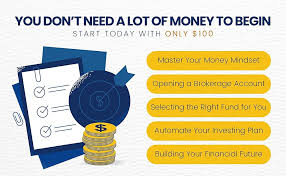
- Steps to Start Investing with $100
- Tips for Successful Investing on a Budget
- Conclusion
1. Why Start Investing with $100?
You may wonder if it’s worth investing with such a small amount of money. The truth is, starting early is one of the most effective ways to build wealth over time. Thanks to compound interest and the power of the stock market, even modest investments can grow significantly if you’re patient and consistent.
Starting with just $100 allows you to:
- Learn the basics of investing without taking on too much risk.
- Build good financial habits that will serve you well in the future.
- Take advantage of long-term growth, even from small investments.
Ultimately, the goal is to get comfortable with investing, learn from the experience, and gradually increase your investment as your financial situation improves.
2. Best Investment Options for Beginners
While you can invest in almost anything, not all options are ideal for beginners with a small budget. Below are some of the best ways to start investing with just $100:
A. Stock Market
The stock market is one of the most common ways to invest. With just $100, you can buy shares of individual companies or exchange-traded funds (ETFs).
- Individual Stocks: Buying stocks of individual companies means you own a small piece of that business. Some companies, like Apple, Amazon, or Tesla, have shares that cost several hundred dollars per share, but there are also smaller companies (called “penny stocks”) or fractional shares available on platforms like Robinhood and Webull, allowing you to invest with just $100.
- ETFs: ETFs are collections of stocks that allow you to invest in an entire sector, index, or theme without needing to buy individual stocks. A popular choice for beginners is the S&P 500 ETF (e.g., SPY or VOO), which gives exposure to 500 of the largest U.S. companies.
B. Index Funds and ETFs
Index funds and ETFs are ideal for beginner investors because they offer instant diversification, meaning your $100 is spread across dozens or even hundreds of different companies. These funds typically have low fees and offer steady returns over time, making them a great choice for long-term investors.
- Vanguard S&P 500 ETF (VOO): This fund tracks the S&P 500, offering exposure to large-cap U.S. companies.
- Fidelity ZERO Total Market Index Fund (FZROX): A low-cost fund that provides exposure to the entire U.S. stock market.
Both options are excellent for long-term investors who want to minimize risk while benefiting from overall market growth.
C. Robo-Advisors
Robo-advisors are automated platforms that create and manage a diversified portfolio for you, based on your financial goals and risk tolerance. They are a great option for beginners because they do all the work for you. With a $100 investment, you can have access to a professional portfolio manager at a fraction of the cost of traditional advisors.
Some popular robo-advisors include:
- Betterment
- Wealthfront
- SoFi Invest
These platforms generally charge low management fees (around 0.25% annually) and make investing as easy as setting up an account and funding it.
D. Real Estate Crowdfunding
Real estate crowdfunding platforms allow you to invest in real estate projects without needing large amounts of capital. Some platforms allow investments as low as $100, giving you exposure to a variety of properties such as residential, commercial, or mixed-use.
Examples of real estate crowdfunding platforms:
- Fundrise
- RealtyMogul
- CrowdStreet
While real estate investing can offer high returns, it can also come with risks, and you should always read the fine print before making any investments.
E. Cryptocurrency
Cryptocurrency has become a hot topic in the investing world. With $100, you can invest in various cryptocurrencies like Bitcoin, Ethereum, or smaller altcoins. However, crypto can be highly volatile, and it’s essential to approach this with caution.
To start investing in crypto:
- Use a secure cryptocurrency exchange like Coinbase or Binance.
- Consider starting small, due to the volatility of the market.
- Never invest more than you’re willing to lose.
If you’re curious about cryptocurrency, doing thorough research and keeping your investments diversified is crucial.
3. How to Build a Diversified Portfolio
The key to successful investing is diversification, which means spreading your investments across different asset classes to reduce risk. With only $100, it may seem challenging to diversify, but it’s still possible.
You could:
- Invest $40 in an S&P 500 ETF for broad market exposure.
- Allocate $30 to a real estate crowdfunding platform.
- Spend $20 on cryptocurrency for some higher-risk, high-reward potential.
- Save $10 in a Robo-advisor account for automated diversification.
This way, you have exposure to stocks, real estate, and crypto—all different types of assets that can perform differently in various market conditions.
4. Understanding Risk in Investing
Investing always involves risk, and it’s important to understand that the value of your investments can rise and fall. Higher-risk investments tend to offer the potential for higher rewards, but they can also result in greater losses.
When you’re starting with $100, you should:
- Assess your risk tolerance: Are you comfortable with volatility? If not, consider safer options like index funds or robo-advisors.
- Invest for the long term: The longer you keep your money invested, the more likely you are to benefit from long-term growth, even with small, consistent investments.
5. Steps to Start Investing with $100
Here’s a step-by-step guide to get started:
- Choose a brokerage or investment platform: Platforms like Robinhood, Webull, Betterment, and Fundrise allow you to start with as little as $100.
- Create an account: Provide your personal information, including your financial goals and risk tolerance.
- Deposit your $100: Link your bank account and transfer the amount you want to invest.
- Pick your investments: Based on your risk tolerance and goals, choose the best investment options from those we’ve discussed.
- Monitor and adjust: Check on your investments periodically and make adjustments if necessary.
6. Tips for Successful Investing on a Budget
- Start small and stay consistent: Even if you can only invest $100, making regular contributions (even if it’s just $10 or $20) can lead to significant growth over time.
- Take advantage of fractional shares: Many platforms offer fractional shares, allowing you to buy a portion of a stock or ETF rather than a full share.
- Reinvest dividends: If your investments pay dividends, reinvest them to take advantage of compound growth.
- Keep fees low: Look for investment options with low management fees, as these can eat into your returns.
7. Conclusion
Investing with just $100 is not only possible but also a smart way to start building wealth. Whether you choose stocks, ETFs, real estate, or cryptocurrency, the important thing is to take the first step and begin your investment journey.
By following the tips in this article and staying patient, you can gradually grow your investments over time. Remember, the earlier you start, the more your money can grow. So, don’t wait—start investing today, even if it’s just $100.